
A clear, practical comparison of patents, trademarks and copyrights for...
Read MoreIntroduction to Patent Search
What is a Patent Search?
A patent search is a structured investigation of existing patents, published patent applications and other publicly available documents to determine if an invention is new and non-obvious. It acts as a primary filter before you commit time and financial resources to the formal patent filing process.
Understanding Prior Art
To understand patent searches, you must understand "prior art". Prior art includes any evidence that your invention already exists. This can be:
- Previously granted patents (globally, not just in India)
- Published patent applications
- Scientific journals and academic papers
- News articles, product brochures and websites
- Public demonstrations or sales of the product
Why Patent Search is the Foundation of a Successful Strategy
You cannot patent something that is already in the public domain. A patent search helps you identify this prior art, reducing the risk of legal disputes. When you know what already exists, you can define the unique boundaries of your own invention. This forms the absolute foundation of a successful patent filing strategy, ensuring your claims are strong, defensible and legally sound.
Ready to find out if your invention is truly unique?
Book a Free Consultation with a BizSecure Patent ExpertThe Need for Patent Search
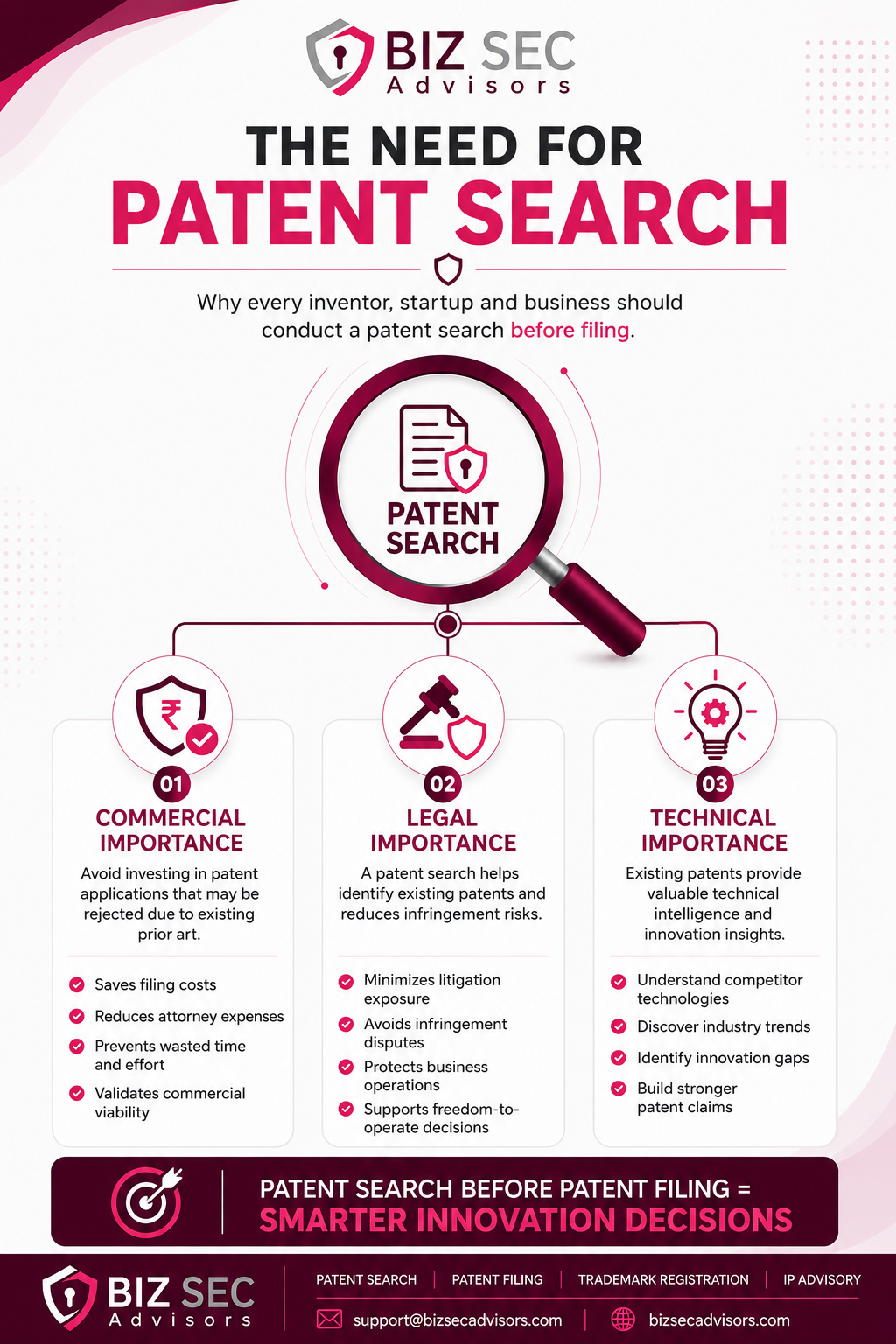
Why must inventors and businesses conduct patent searches before filing? The answers fall into three distinct categories:
Commercial Importance
Filing a patent requires a significant investment. If your application gets rejected because a similar product already exists, you lose your filing fees, attorney fees and valuable time. A search validates your commercial viability before you spend a single rupee on filing.
Legal Importance
Ignorance is not a valid legal defence. If you manufacture or sell a product that infringes on an existing patent, the patent holder can sue you for damages. A thorough search minimises this risk.
Technical Importance
Reviewing existing patents gives your research and development (R&D) team technical insights. They can see how competitors solved similar problems and improve upon those solutions, creating a stronger, more innovative product.
Importance of Patent Search
Investing in a patent search provides immense value to your business operations:
- Assess novelty and inventiveness: the Indian Patent Office (IPO) requires all patents to be novel and have an inventive step — a search confirms your invention meets these strict criteria.
- Understand existing technologies: you gain a clear picture of the current technology landscape.
- Reduce rejection risks: knowing the prior art enables your attorney to draft claims that avoid overlap with existing patents, drastically reducing the risk of rejection.
- Save time and costs: a patent application can take years to process — discovering your invention is not patentable on day one saves years of waiting and thousands in legal fees.
Advantages of Patent Search
- Better patent drafting: attorneys use search reports to draft precise, highly specific claims.
- Stronger claims: by navigating around prior art, your granted patent becomes much harder for competitors to invalidate.
- Competitive intelligence: you learn exactly what your competitors are developing and patenting.
- Improved R&D strategy: your engineering teams can focus on open market whitespace rather than reinventing the wheel.
- Market understanding: search data reveals market trends and potential consumer demands.
- Licensing opportunities: you might find existing patents you can license instead of spending money on internal R&D.
Disadvantages of NOT Conducting a Thorough Patent Search
Skipping this vital step exposes you and your business to massive risks:
- Risk of rejection: the patent examiner will easily find obvious prior art and reject your application.
- Patent infringement litigation: you might accidentally manufacture a patented product, leading to devastating lawsuits.
- Wasted filing fees: all money spent on drafting and filing is lost if the patent is rejected.
- Weak patent claims: without knowing the prior art, you might draft overly broad claims that get challenged and invalidated later.
- Business risks: investors often require proof of the startup's freedom to operate before funding.
- Product launch issues: a competitor could file an injunction right as you launch your flagship product.
Don't risk your startup's future on a simple oversight.
Get a Professional Patentability AssessmentTypes of Patent Search
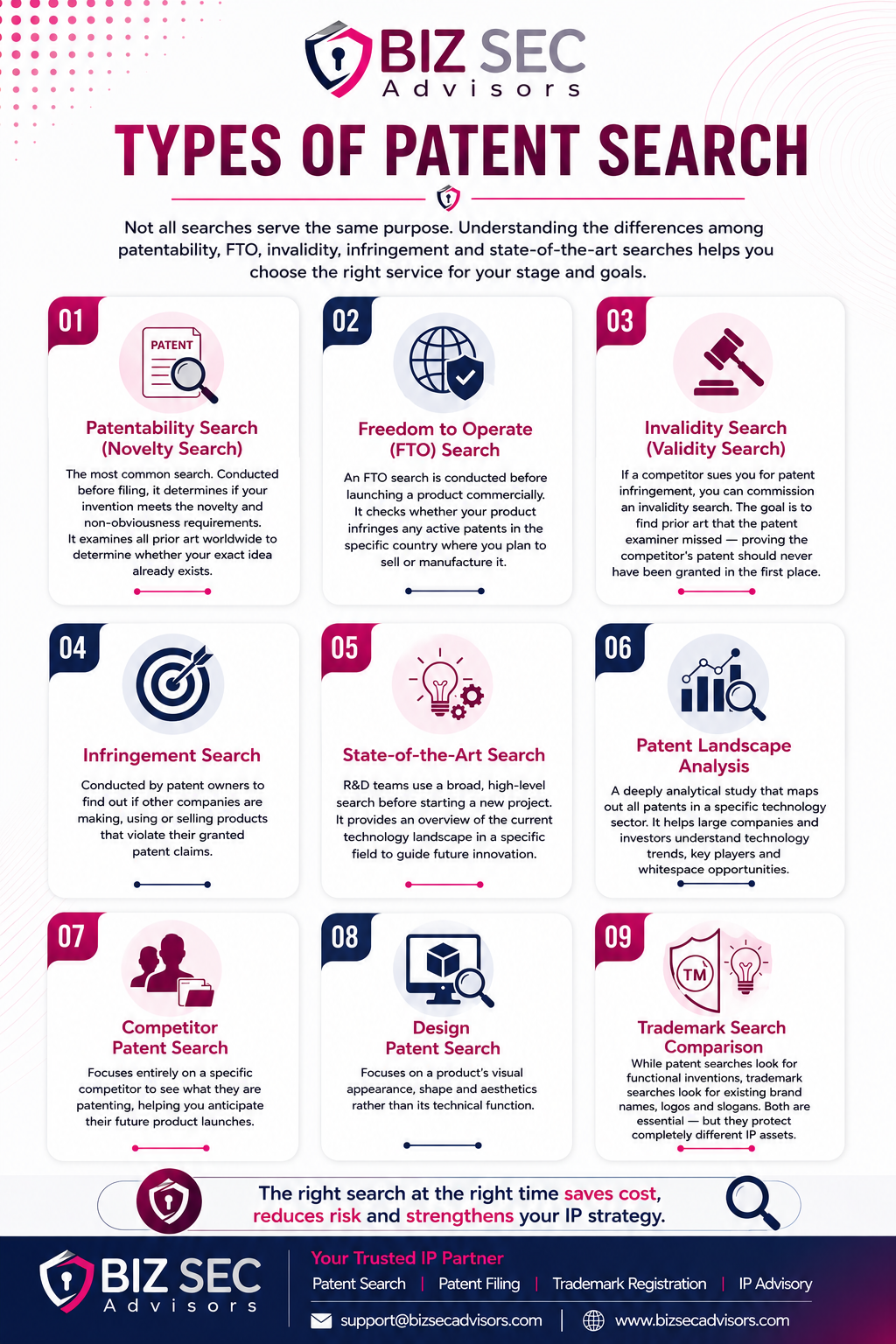
Not all searches serve the same purpose. Understanding the differences among patentability, FTO, invalidity, infringement and state-of-the-art searches helps you choose the right service for your stage and goals.
i. Patentability Search (Novelty Search)
The most common search. Conducted before filing, it determines if your invention meets the novelty and non-obviousness requirements. It examines all prior art worldwide to determine whether your exact idea already exists.
ii. Freedom to Operate (FTO) Search
An FTO search is conducted before launching a product commercially. It checks whether your product infringes any active patents in the specific country where you plan to sell or manufacture it.
iii. Invalidity Search (Validity Search)
If a competitor sues you for patent infringement, you can commission an invalidity search. The goal is to find prior art that the patent examiner missed — proving the competitor's patent should never have been granted in the first place.
iv. Infringement Search
Conducted by patent owners to find out if other companies are making, using or selling products that violate their granted patent claims.
v. State-of-the-Art Search
R&D teams use a broad, high-level search before starting a new project. It provides an overview of the current technology landscape in a specific field to guide future innovation.
vi. Patent Landscape Analysis
A deeply analytical study that maps out all patents in a specific technology sector. It helps large companies and investors understand technology trends, key players and whitespace opportunities.
vii. Competitor Patent Search
Focuses entirely on a specific competitor to see what they are patenting, helping you anticipate their future product launches.
viii. Design Patent Search
Focuses on a product's visual appearance, shape and aesthetics rather than its technical function.
ix. Trademark Search Comparison
While patent searches look for functional inventions, trademark searches look for existing brand names, logos and slogans. Both are essential — but they protect completely different IP assets.
Deep Dive: Freedom to Operate (FTO) Search
What is FTO?
Freedom to Operate (FTO) determines whether testing, manufacturing or commercialising a product can be done without infringing on the valid intellectual property rights of others.
Why FTO Matters Before Manufacturing
Imagine spending millions building a manufacturing plant for a new medical device — only to receive a cease-and-desist letter on launch day. FTO clears the path, ensuring your commercialisation strategy is legally safe.
FTO vs. Patentability Search
- Patentability Search: looks at everything ever published globally (active patents, expired patents, non-patent literature) to see if you can get a patent.
- FTO Search: looks only at active patents in the specific countries where you want to do business, to see if you will get sued.
Industries Where FTO is Critical
FTO is absolutely mandatory in heavily regulated and highly innovative sectors, including:
- Pharmaceuticals and Biotechnology
- Software and SaaS
- Telecommunications
- Automotive manufacturing
- Medical Devices
Common Mistakes During FTO Analysis
Many startups mistakenly assume that having a granted patent automatically gives them Freedom to Operate. This is a dangerous myth. You can hold a patent for a specific improvement on an existing technology, but you still cannot manufacture it if the base technology belongs to someone else. This is why legal interpretation is crucial. Reading patent claims requires specialised legal expertise. Professional FTO services from firms like BizSecure Advisors ensure you get accurate risk assessments, not just a list of search results.
Planning a major product launch in India or abroad?
Request a Detailed Freedom to Operate (FTO) ReportImportant Patent Search Tools & Databases
Conducting an effective patent search requires access to the right databases.
InPASS (Indian Patent Advanced Search System)
InPASS is the official database provided by the Indian Patent Office (IP India). It allows users to conduct a comprehensive patent search in India.
Key features of InPASS:
- Boolean search — connect keywords using AND, OR, NOT
- Advanced filtering — filter by date, applicant or status
- Applicant / inventor search — track specific companies or individuals
- Full-text search — search the entire document, not just titles
- PDF access — download the actual patent specifications
- Legal status tracking — check if a patent is active, abandoned or expired
- Classification search — search by technical IPC categories
Google Patents
A highly user-friendly, free database. It indexes patents from over 100 patent offices worldwide and automatically translates foreign patents into English. Excellent for preliminary prior art searches.
WIPO PATENTSCOPE
Operated by the World Intellectual Property Organization, this database allows you to search international Patent Cooperation Treaty (PCT) applications in full-text format.
Espacenet
Managed by the European Patent Office (EPO), this database offers access to over 130 million patent documents worldwide. It features an excellent classification search tool.
USPTO Patent Search
The official database of the United States Patent and Trademark Office. Essential for any Indian company planning to export to the US.
Free vs. Paid Patent Databases
While Google Patents and InPASS are excellent free tools, professional IP firms use paid, subscription-based databases (like Derwent or PatBase). These paid tools offer superior data analytics, better translation of Asian patents and more robust chemical-structure searching capabilities.
Step-by-Step Process to Perform a Patent Search
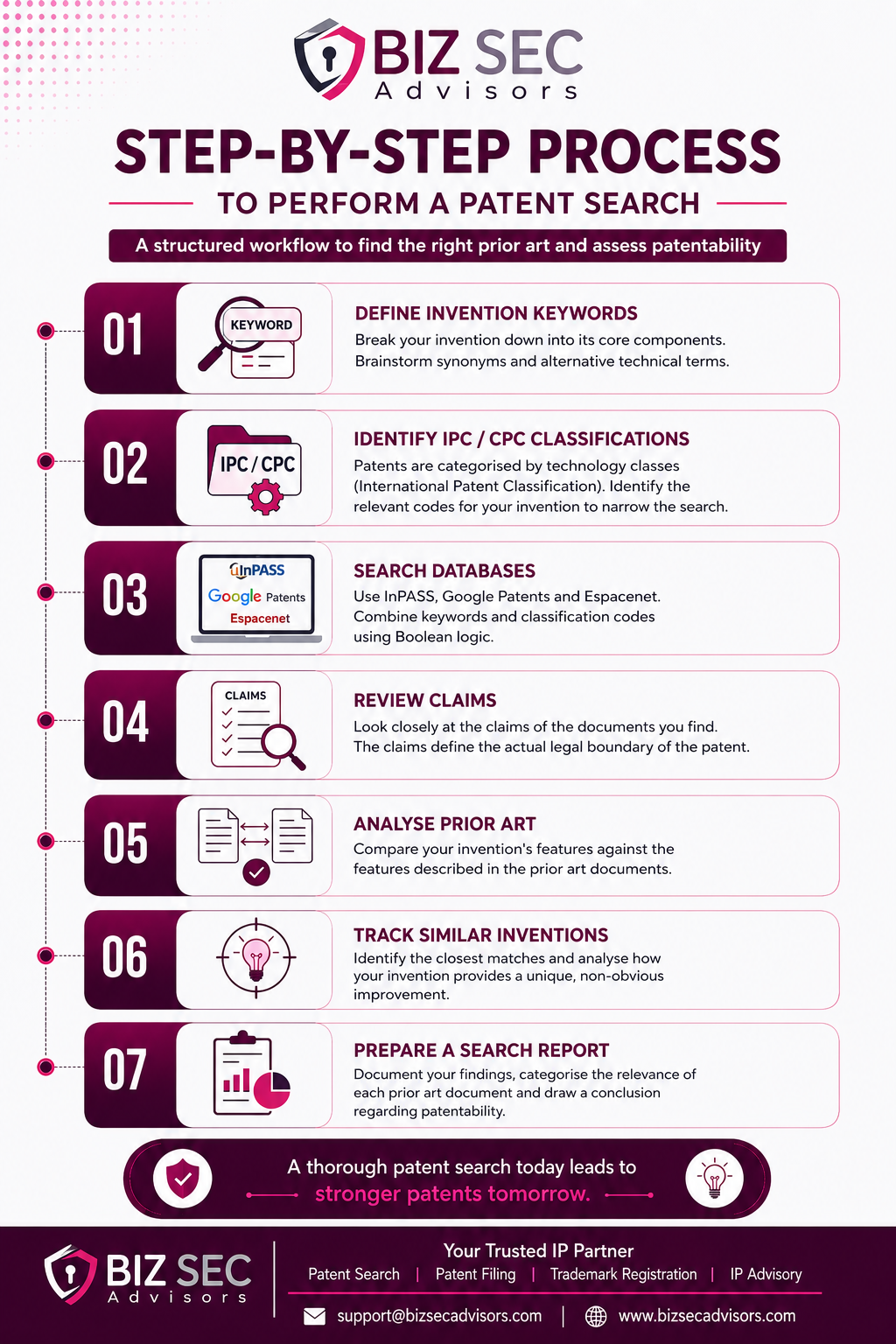
If you want to understand how the process works, here is a standard workflow:
- Define invention keywords — break your invention down into its core components. Brainstorm synonyms and alternative technical terms.
- Identify IPC / CPC classifications — patents are categorised by technology classes (International Patent Classification). Identify the relevant codes for your invention to narrow your search.
- Search databases — use InPASS, Google Patents and Espacenet. Combine keywords and classification codes using Boolean logic.
- Review claims — look closely at the claims of the documents you find. The claims define the actual legal boundary of the patent.
- Analyse prior art — compare your invention's features against the features described in the prior art documents.
- Track similar inventions — identify the closest matches and analyse how your invention provides a unique, non-obvious improvement.
- Prepare a search report — document your findings, categorise the relevance of each prior art document and draw a conclusion regarding patentability.
Who Should Conduct a Patent Search?
A patent search is a critical business activity for various stakeholders:
- Startups — to secure valuation, attract investors and avoid infringement.
- Corporates — to map competitor activities and build robust IP portfolios.
- Researchers / Universities — to ensure their academic work translates into commercial value.
- Manufacturers — to clear FTO before setting up production lines.
- Software Companies — to navigate the complex landscape of algorithms and software patents.
- Pharma Companies — to track drug formulations and plan generic entries after patent expiry.
Challenges in Conducting a Patent Search
Conducting a reliable search is not as simple as typing a query into Google. You will face several hurdles:
- Complex technical terminology — patent attorneys often draft patents using broad, deliberately obtuse language (e.g. calling a "wheel" a "circular rolling support element"). If you only search for "wheel" you will miss critical prior art.
- Language barriers — much of the world's prior art is published in Chinese, Japanese or Korean.
- Hidden prior art — applications are kept secret for 18 months after filing. You cannot search for what is not yet published.
- Legal interpretation — reading a patent claim requires understanding patent-law doctrines, which is difficult for laypersons.
The solution: partnering with expert patent attorneys bridges the gap between technical understanding and legal interpretation.
Benefits of Professional Patent Search Services in India
Why should businesses hire experts instead of doing it themselves?
- Accuracy — professionals use premium databases and advanced syntax to uncover hidden prior art.
- Time savings — an expert can do in one week what might take an untrained inventor months to compile.
- Strategic advice — professionals don't just hand you a list of patents. They advise you on how to modify your invention to bypass existing prior art successfully.
- Reduced rejection risk — high-quality search reports directly influence the drafting process, leading to higher patent-grant success rates.
- Professional search reports — you receive a formal, documented report that can be shared with investors or board members to prove due diligence.
Why Hire BizSecure Advisors for Patent Search Services?
BizSecure Advisors stands out as a premier Intellectual Property consulting firm in India. We help innovators protect their future. Here is why you should partner with us:
- Experienced professionals — our team consists of registered patent agents, technical subject-matter experts and seasoned IP lawyers.
- End-to-end support — we don't just search; we guide you through patent drafting, filing and prosecution.
- Detailed search reports — we provide crystal-clear, actionable reports categorised by relevance, complete with legal opinions.
- Technology-driven research — we leverage advanced, paid databases to ensure no prior art goes unnoticed.
- Startup-friendly support — we understand the budget constraints of early-stage startups and offer affordable, transparent pricing.
- Confidentiality — we sign strict Non-Disclosure Agreements (NDAs) before you even share your idea with us.
Ready to protect your innovation with confidence?
Speak with a BizSecure Patent Expert TodayConclusion: Secure Your Innovation Today
A patent is a powerful business asset that can secure your market position, attract investment, and drive revenue. However, navigating the complex world of Intellectual Property requires precision, expertise, and due diligence. Skipping the patent search process is a gamble no serious business owner should take. By conducting a comprehensive patentability search or FTO analysis, you eliminate guesswork. You gain a clear understanding of your competitive landscape, reduce legal risks, and build a highly defensible IP portfolio.
At BizSecure Advisors, we combine deep technical expertise with sharp legal acumen to deliver patent search services you can trust. Whether you are a solo inventor with a breakthrough idea or a growing startup preparing for a major product launch, our team is here to guide you every step of the way.
Suggested Next Steps:
- Sign an NDA with our team to protect your idea.
- Request a comprehensive Patentability Search Report.
- Let our experts draft and file your patent application with the Indian Patent Office.
Take the first step toward securing your intellectual property.
Take the first step toward securing your intellectual property.
Contact BizSecure Advisors for a Free IP Assessment
Online Patent Filing Process in India: Step-by-Step Guide
A clear, practical comparison of patents, trademarks and copyrights for...
Read More
Role of patent attorney in patent filing process
A clear, practical comparison of patents, trademarks and copyrights for...
Read More
Patent Filing for Startups in India
A clear, practical comparison of patents, trademarks and copyrights for...
Read More

-
BizSec Advisors is a very good company and they work at very low prices and handle people with great love and do their work very well.

OLDYGOLDYCARE PRIVATE LIMITED
April 9, 2026It is an excellent company, Sir—truly superb. Moreover, they handle your minor tasks completely free of charge, and they get the work done very quickly.
Himani Healthcare Services
April 9, 2026 Mughesh Kumar N R
April 5, 2026 -
I had a great experience with BizSec Advisors for filing the patent of my IoT-based attendance system for workers. Their team was highly professional, knowledgeable, and supportive throughout the entire... read more
Yoga Vignesh v
April 4, 2026Excellent service, Very cost effective, customer friendly. My patent hearing went on smoothly and utility patent granted successfully. Thankful to BizSec Advisors...
Dr Balaji Ganesh R
April 3, 2026